The question
Many people play brown, pink, white or blue noise to study or sleep. These noises spread sound energy across frequencies differently: brown noise is weighted toward low frequencies and blue noise toward high ones.
C. elegans is a common model organism because it shares many genes with humans. I tested whether these noises change its chemotaxis, the way it moves toward or away from a chemical, in this case salt (NaCl). I hypothesized that brown noise would have the greatest effect and that the worms would move toward the salt.
Methods
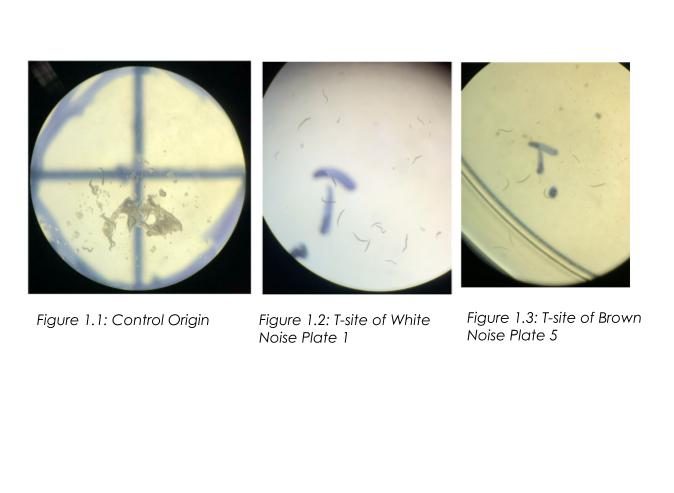
I cultured worms on NGM agar plates seeded with E. coli OP50, then washed them and placed them at the center of assay plates divided into four sections, with salt at two test sites and water at two control sites.
Each plate sat on a speaker for 60 minutes under one of five conditions: silence, brown, pink, white or blue noise, with five replicate plates per condition. I counted the worms at each site, calculated a chemotaxis index for each plate, and compared the conditions with a one-way ANOVA.
Results
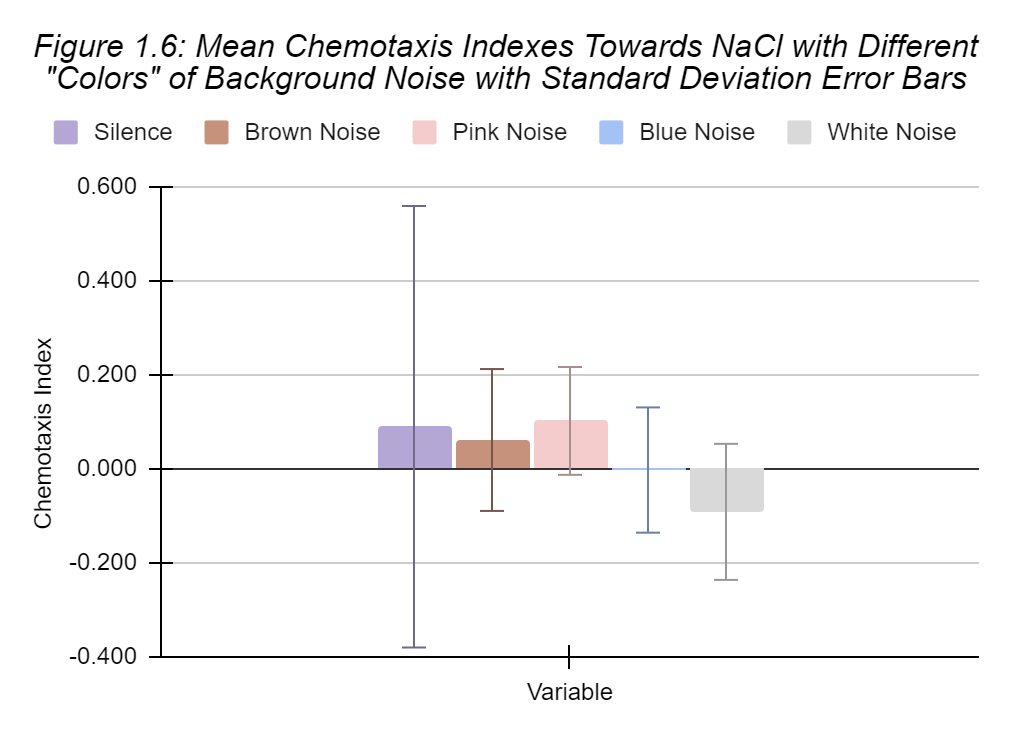
There was no significant difference between the conditions (p = 0.708), so the hypothesis wasn't supported. Every mean chemotaxis index was close to zero, meaning the worms split fairly evenly between salt and water.
There was a pattern, though. Brown and pink noise, which emphasize lower frequencies, had positive mean indexes. Blue and white noise had slightly negative ones. This fits an earlier study where C. elegans responded most strongly at 23 Hz, the lowest frequency tested.
What I'd change
The silence condition had much more spread than the others because many worms stayed clumped at the starting point. It was my first time washing worms, and I didn't break up the pellet enough. Better washing and more replicates would make a difference easier to detect.
Recognition
I presented this project at two regional science fairs and won 2nd place at the Jersey Shore Science Fair.